

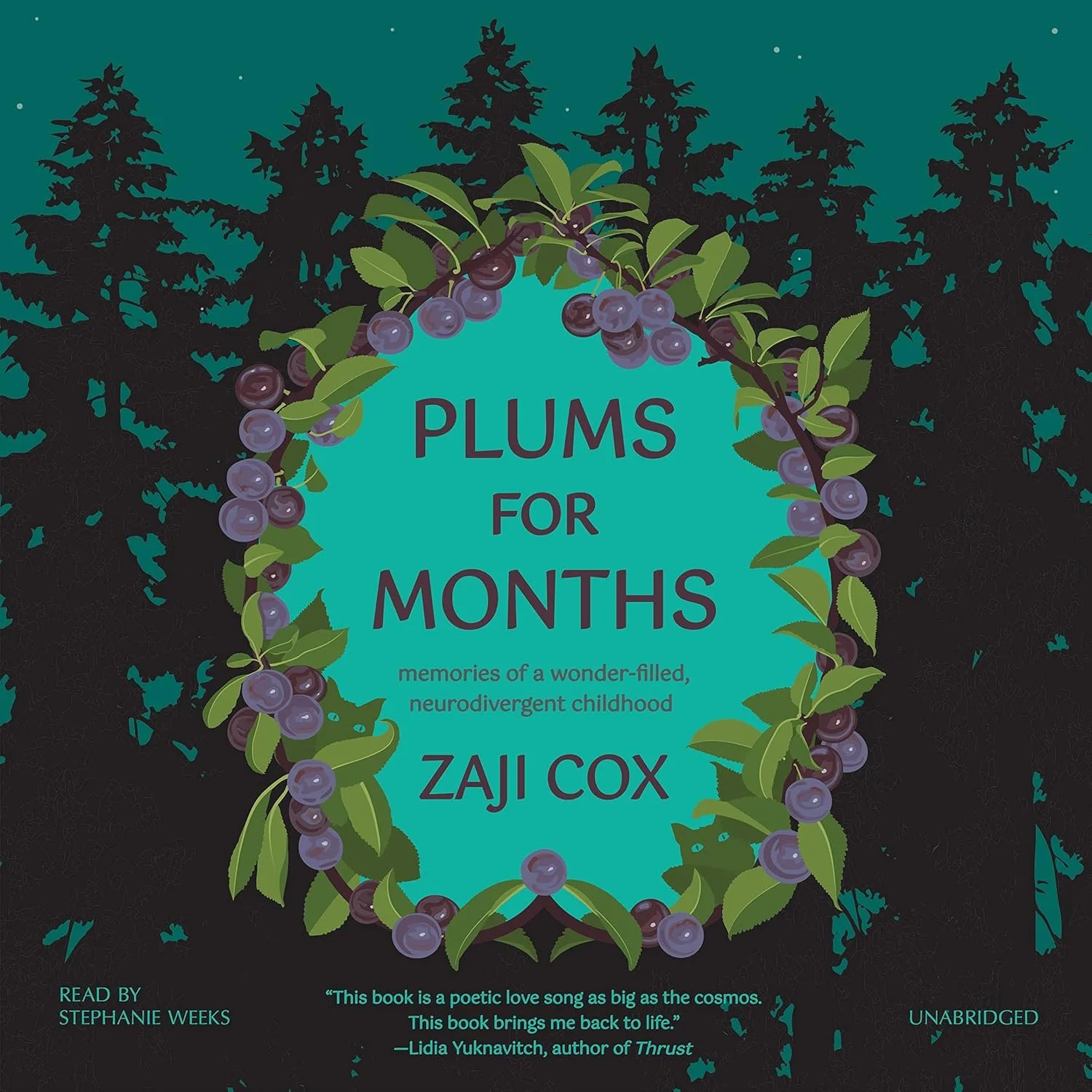
Review: Plums for Months
In Plums for Months, Zaji Cox offers readers a glimpse into her childhood and adolescence in a series of colorful and concise pieces that center family, nature, art, and (un)belonging. Cox writes with rich variety: her collection is comprised of short essays, lists, experimental flash pieces, gymnastic routine scorecards, and even science homework. Despite a vacillation between different writing styles that can verge on frenetic, each scene in the book hangs together with delicate cohesion, sometimes complementing its neighboring entries thematically or formally, other times defying expectation and capitalizing on stark juxtaposition. The pace, tempo, and choreography of Cox’s writing seem informed by her artistic and athletic pursuits; she went from competitive gymnastics to professional dance and has performed with the New Mexico Ballet Company and the Polaris Dance Theater, among others.
A precocious child when it came to words, Cox was reading by age three, wrote her first short story at age nine, and published her first book in 2016. Her writing illustrates her struggles against the status quo—Cox is a neurodiverse woman of color, and even though she grew up outside of Portland, Oregon, a part of the country that is relatively culturally inclusive, Plums for Months is in part a book about stereotypes and how Cox defies them.
Review: Post-Truth Rhetoric and Composition
“Post-Truth Rhetoric and Composition is a field guide for the modern-day media consumer, a portable, practical booklet meant to help readers make sense of the news in a rhetorical ecology overwhelmed by alternate facts and truthy bullshit. The author Bruce McComiskey maintains that hate and fear are crowding out reasoned opinion and logical argument, but a return to a saner public discourse isn’t yet out of reach. By identifying post-truth rhetoric and its subsets, and by teaching the tools to communicate ethically and with integrity, McComiskey believes that we can perhaps make America tell the truth again.
The book starts with a brief preamble followed by three main sections: ‘Post- Truth Rhetoric,’ ‘Post- Truth Composition,’ and ‘Consequences of Neglecting to Act.’ Regarding the author’s place in the scheme of things, it’s important to note that he doesn’t overinflate his role. ‘My intent is not to solve the problem of post-truth rhetoric,’ he writes, ‘but only to define and describe it’ (6).”